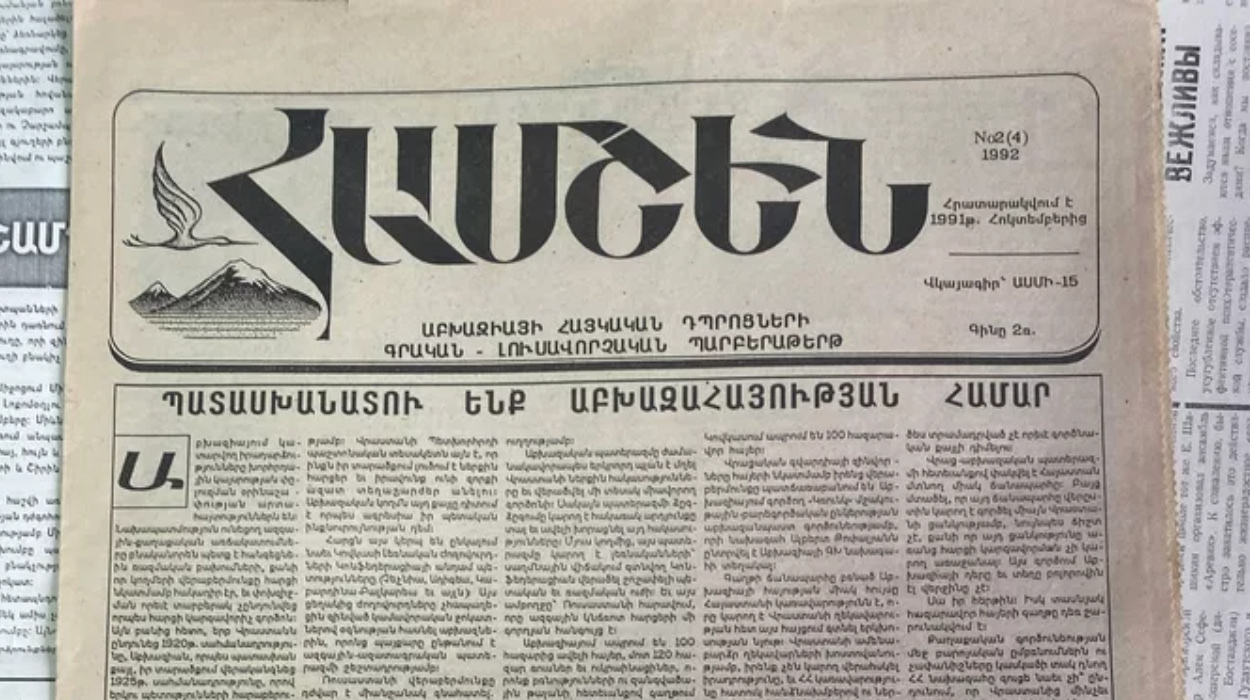
An Armenian-language newspaper founded in Abkhazia 35 years ago kept publishing through war and hardship, introduced Abkhazian literature to Armenian readers, and once survived only because the president stepped in.
The first issue of Hamshen appeared on 15 October 1991. It was written for Abkhazia's Armenian community, but regularly carried Abkhazian authors too, including poetry translated into Armenian.
The paper was the idea of journalist and poet Artavazd Saretsyan, then executive secretary of Respublika Abkhazia, the newspaper he now runs as acting editor-in-chief.
Hamshen has not been published for five years, but Saretsyan still keeps its back issues and can recall almost every article.
Printed in Yerevan
The first issue was printed in Yerevan in a run of 5,000 copies. Its front page showed Mount Ararat, a nod to the origins of Abkhazia's Hamshen Armenians.
From then on the paper appeared monthly, and at times more often.
Publishing in wartime
The fourth issue came out in September 1992, during the Patriotic War. It reported raids and looting in Armenian villages, whose residents were being branded enemies.
Saretsyan's article 'How long will our home keep being destroyed?' was reprinted by Armenian publications in Yerevan.
Colleagues urged him not to publish, as his life was at risk and his family was still in Sukhum. He went ahead anyway, distributing copies in Krasnodar and in occupied Sukhum.
Georgian guardsmen once came to arrest him but went to the wrong street, stopping at his aunt's house instead. She persuaded them that no such man had ever lived nearby. Saretsyan and his son carried on delivering the paper by car to Armenian villages.
A start for young writers
After the war Hamshen was printed in Abkhazia, publishing established Abkhazian writers such as Vitaly Amarshan, Mushni Lasuria and Juma Akhuba.
It also gave young people their first break. The journalist Eleonora Geloyan, formerly of Abaza-TV, gave her first interview to the paper while still at school.
Nina Gasparyan first appeared in its pages aged ten. She is now a philologist and literary editor for leading Russian publications, and recently wrote to her first editor that her journey began with those early pieces.
Summoned by the president
Saretsyan met President Vladislav Ardzinba only twice. At the first meeting, the president recognised him at once as the editor of Hamshen.
'I was very surprised that the president reads us,' Saretsyan recalls.
The second meeting came in the lean post-war years, when no issue had appeared for three months. An aide arrived to ask why, and Saretsyan explained there was no money. Soon afterwards he was summoned.
Ardzinba told him the paper had to resume, because nobody would mention financial difficulties. People would simply say that an Armenian newspaper had been shut down in Abkhazia. The next issue led with an interview with the president.
Final issue
Saretsyan also founded the Hamshen library and translated Abkhazian poetry and prose into Armenian, work that had barely been attempted before him. His translations include works by Dmitry Gulia, Bagrat Shinkuba and Juma Akhuba.
The last issue appeared in October 2021, marking the paper's 30th anniversary. Saretsyan says his health no longer allowed him to continue, and that newspapers have lost much of their readership.
He was awarded the Akhdz-Apsha Order, 3rd class, in 2012, and holds the William Saroyan Medal of Armenia's Ministry of Diaspora for strengthening Armenian-Abkhazian ties.
Source: AbkhazWorld.com