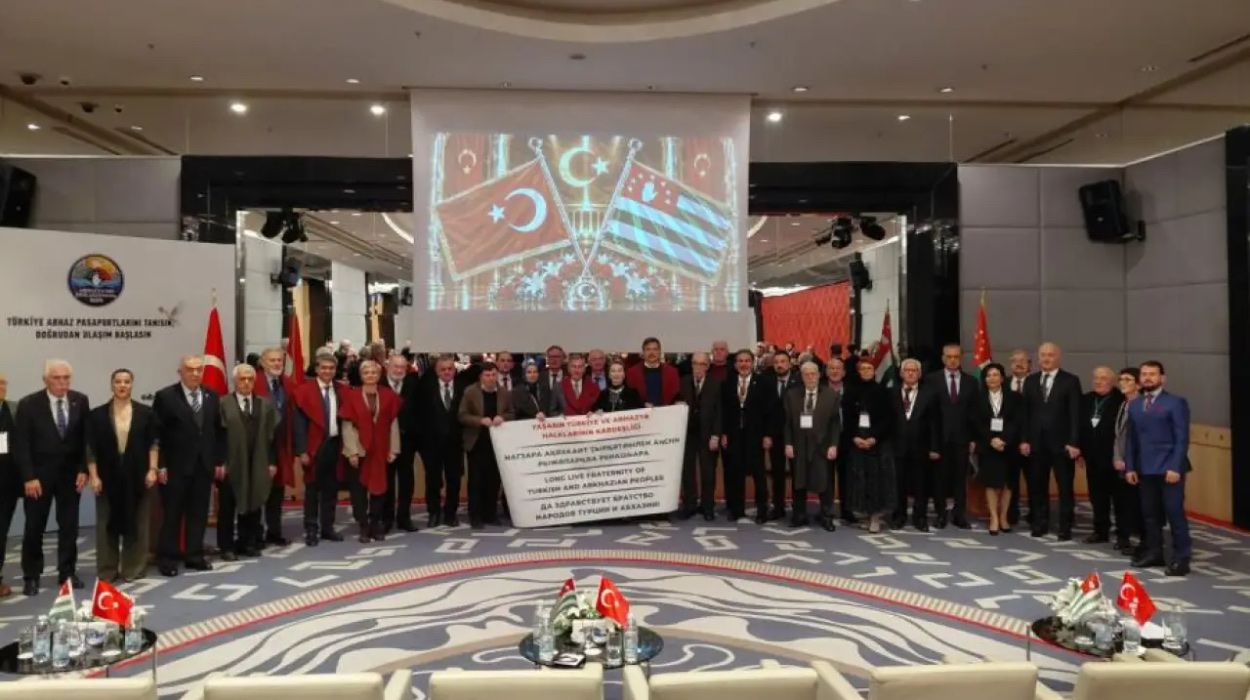
Deputies from across Türkiye's political spectrum have set up a 'Friendship Group with Abkhazia', pledging to push for Turkish recognition of Abkhazian passports and official documents and for the return of direct transport links between the two countries.
The group held its founding meeting at a hotel in Ankara on the evening of 17 November. It was organised by opposition members of the Grand National Assembly of Türkiye together with the 'End the Isolation of Abkhazia' initiative (Abhazya İzolasyonuna Son).
More than 20 deputies attended, representing nine political parties, according to the Abkhazian state news agency Apsnypress. The parties named by the organisers included the New Party, the Felicity Party, the DEM Party, DEVA, the Labour Party (EMEP), the Workers' Party of Türkiye (TİP) and New Path. Turkish press reports also mentioned the Democrat Party and said deputies from İYİ and the New Welfare Party were present.
Also attending were Ibrahim Avidzba, the plenipotentiary representative of the Republic of Abkhazia in Türkiye; Yaşar Aslankaya (Khagundoko), head of the Federation of Caucasian Associations (KAFFED); and representatives of cultural and civic organisations and of the Abkhaz and Circassian diaspora in Türkiye.
The delegation from Abkhazia was led by Inar Gitsba and Demur Gogia, both members of the People's Assembly. It also included Guli Kichba, secretary of the Public Chamber; Vadim Kharazia, adviser to the chairman of the State Committee for Repatriation; Inal Khutaba, head of the committee's diaspora relations department; Gugutsa Dzhikirba, director of the S. Dbar Museum of Military Glory in Gudauta; the writer and public figure Oktai Chkotua; and Timur Rekvava, head of the Sukhum office of the World Abkhaz-Abaza Association.
Opening the meeting, Anıt Baba, who chairs the initiative and is one of the group's founders, set out the work done so far and the plans ahead. He described the 30 years of isolation imposed on Abkhazia as a crime against humanity.
Speaking on behalf of the delegation, Gitsba said that overcoming the republic's international isolation was essential and that recognition of Abkhazian documents in Türkiye would resolve a number of pressing problems for its citizens. He set out three demands: acceptance of the Abkhazian passport as a valid travel document, an end to the trade embargo, and direct passenger and freight routes. He noted that Türkiye already supplies Abkhazia with food and medicine and is its second-largest trading partner.
Participants gave particular attention to the humanitarian side of the campaign. They said that because Abkhazian documents are not accepted, citizens face obstacles in gaining an education, receiving medical treatment, travelling freely and keeping in touch with relatives on the other side of the Black Sea.
The problem was illustrated by the meeting itself. Two Abkhazian figures who had been invited, Akhra Bzhania and Aslan Kobakhia, were unable to travel to Ankara because neither holds a Russian passport. Bzhania sent a written address instead.
Gogia said he was confident that the joint efforts of Turkish deputies and the Abkhaz and Circassian diaspora would move the initiative forward and strengthen ties between the two peoples. Kichba stressed the importance of working together and said she was sure the group would achieve its aims. Chkotua spoke of the historical, cultural and fraternal bonds between Abkhazia and Türkiye, calling the new group an important step in relations between the two countries.
Turkish speakers, among them Sevda Karaca, Erkan Baş, Ömer Faruk Gergerlioğlu, Mehmet Erdoğan, Mehmet Emin Ekmen, Selçuk Özdağ and Mehmet Altınöz, backed the calls for humanitarian access, recognition of passports and the restoration of the sea link. Okan Konuralp told the meeting he was the only member of parliament of Abkhazian descent.
The campaign has also won the backing of a coordination council of North Caucasian organisations in Istanbul, which represents 24 groups. On 2 November, Mahmut Tanal tabled a motion in parliament calling for an inquiry into the issue.
Georgian diaspora organisations in Türkiye issued a statement opposing the initiative. Tbilisi has not commented officially.
The campaign began on 29 June 2026, when supporters started filing petitions to the Turkish Foreign Ministry through CİMER, the state's online petition system. Direct sea traffic between Trabzon and Sukhum ended in 1996.
Participants said the group's main priority would be to deliver concrete results, above all the recognition of Abkhazian passports and official documents in Türkiye.