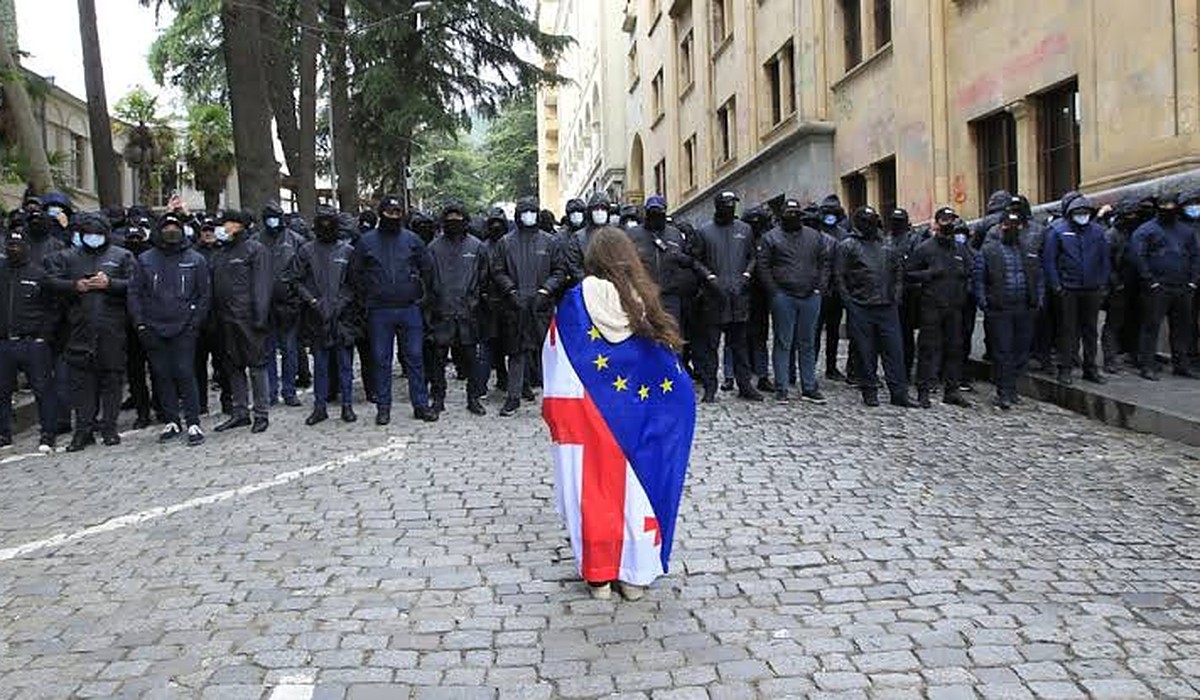
Europe's leading constitutional watchdog has said a package of laws passed by Georgia's ruling party in March risks crushing political opposition and civil society, rather than protecting the country from foreign interference as the government claims.
In a strongly worded opinion published on Tuesday, the Council of Europe's Venice Commission said the legislation imposed 'disproportionate and unnecessary restrictions' on the basic rights of Georgian citizens.
The advisory body, which assesses whether laws meet democratic and constitutional standards, concluded that the measures were contrary to international norms on pluralism and democracy.
It said that far from shielding Georgia's sovereignty and its political parties from outside influence, the laws risked seriously undermining them.
What do the laws do?
The amendments, adopted by parliament on 4 March, changed the law on grants, the law on political associations of citizens and the criminal code, among other legislation.
They widened the legal meaning of a grant to cover technical assistance, the sharing of knowledge and expertise, services and other forms of cooperation. Some of these newly defined grants can only be accepted with the government's prior approval.
The commission said the wording was so broad that people and organisations could not tell whether ordinary activities were covered. It gave academic exchanges, training programmes, research projects and policy discussions as examples.
Receiving or using a foreign grant without permission can now lead to a prison sentence of up to six years.
The commission said criminal law should only be used as a last resort, and urged the authorities to deal with such breaches through administrative measures with proper safeguards instead.
Ban on party membership
The opinion also criticised a provision barring anyone who has been employed by an organisation deemed to pursue the interests of a foreign power from joining a political party for eight years.
The ban applies whether or not the person broke the law, acted on behalf of a foreign power or exerted any improper influence.
The commission warned that this could put people off taking part in political life well beyond those directly affected, and could prevent a political opposition from forming or surviving.
It also raised concerns about new powers for the State Audit Office to monitor the finances of political parties and others, including provisions allowing people to be summoned before a magistrate for questioning. It said these powers needed clearer limits and stronger protection against arbitrary use.
Rushed through parliament
The package was registered in parliament on 21 January and passed all three readings in under six weeks.
According to the commission, the explanatory notes to the bills stated that no experts, organisations or working groups had been involved in drafting them, and that no comparison with other countries' laws had been carried out.
Representatives of the government and the ruling Georgian Dream party declined to meet the commission's delegation when it held consultations in September. The State Grant Management Agency and the State Audit Office also refused to meet.
The commission said it regretted the authorities' unwillingness to engage but remained open to dialogue.
Worsening relations with Europe
The opinion is the latest in a series of critical assessments from Strasbourg.
In October last year, the Venice Commission called on Georgia to repeal its foreign agents registration law, along with earlier changes to the grants and broadcasting laws that restricted foreign funding. In April, a separate Council of Europe expert body said the March amendments were entirely unacceptable for a member state.
Georgian Dream has grown increasingly hostile towards the commission as its relations with the West have deteriorated. In January, the speaker of parliament, Shalva Papuashvili, dismissed it as a political tool used to impose agendas on other countries.
The government says the laws are needed to protect Georgia from foreign meddling. Critics at home and abroad say they are designed to silence independent media, non-governmental organisations and the opposition.