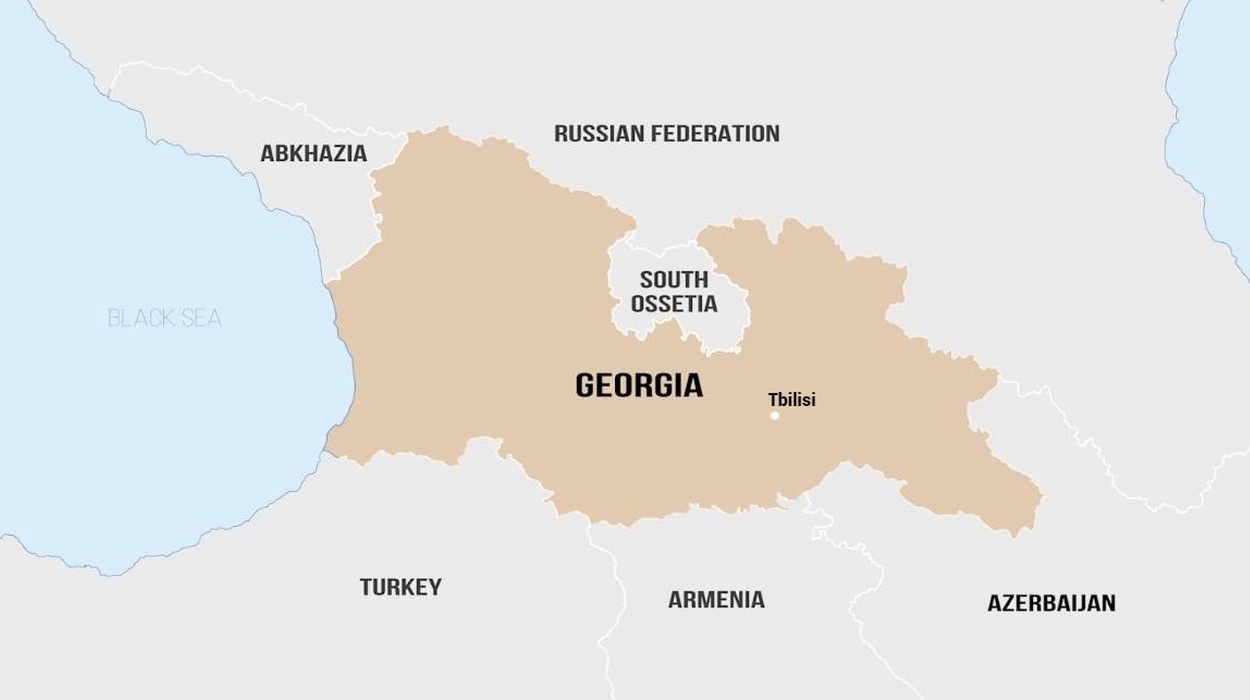
Georgia's Constitutional Court has begun hearing a lawsuit by the governing Georgian Dream party that seeks to ban the country's five main opposition parties. Critics say the case could pave the way for one-party rule.
The court opened three days of hearings in the Black Sea city of Batumi on Wednesday. Its ruling, which must be delivered by June 2027, will be final and cannot be appealed.
Georgian Dream, which has governed since 2012, first filed the suit a year ago against three opposition groups and later widened it to five: the United National Movement (UNM), Coalition for Change, Strong Georgia–Lelo, the Federalists and For Georgia. All are pro-Western and support integration with the EU and Nato. Only For Georgia holds seats in parliament, after other opposition parties boycotted the legislature in protest at the 2024 election result.
'A real threat'
The ruling party argues that the five pose 'a real threat to the constitutional order'. It accuses them of seeking to overthrow or violently change the constitutional order, undermining Georgia's independence, violating its territorial integrity and stoking tensions with Russia. Prime Minister Irakli Kobakhidze has called the parties 'inherently unconstitutional'.
Much of the evidence comes from a parliamentary commission, chaired by the Georgian Dream MP Tea Tsulukiani, which investigated alleged crimes and abuses under the UNM governments of former President Mikheil Saakashvili between 2003 and 2012. Its inquiry included the August 2008 war with Russia over South Ossetia. Transparency International has described the commission as 'an illegal mechanism created by Georgian Dream to destroy opposition parties'.
The move was foreshadowed by Bidzina Ivanishvili, the billionaire founder of Georgian Dream, who said before the October 2024 election: 'We will initiate a legal process that will result in the banning of the United National Movement.' Georgian Dream has signalled that other parties could face similar proceedings.
'Depriving the country of democracy'
The opposition says the case is politically motivated and designed to eliminate its main rivals. Nika Gvaramia of Coalition for Change said the ban was 'about depriving the country of democracy', not simply about removing opposition politicians. Giorgi Butikashvili, the party's foreign secretary, told Reuters the ruling would deprive 'a large part of Georgian society of genuine political choice'.
The four opposition groups that cleared the threshold in 2024 won nearly 800,000 votes between them, more than a third of the total, according to the Central Election Commission. The opposition alliance has promised to protest 'fearlessly and forcefully', with a month of rallies under the slogan 'Georgia Without Ivanishvili' due to begin on 25 October and run until 28 November, the second anniversary of the 2024 protests.
Kornely Kakachia, a professor of political science at Tbilisi State University, told Reuters that 'Georgia is moving from democratic backsliding towards the potential consolidation of authoritarianism'.
EU concern
The European Union has condemned the case. European Commission spokesman Christian Wigand said the developments pointed to 'a concerning instrumentalisation of the judicial system', and warned that they threatened basic freedoms, political pluralism and fair competition. The Council of Europe's secretary general has also urged Tbilisi to uphold political pluralism.
Georgia was granted EU candidate status in 2023, but Brussels now regards it as a candidate in name only. In November 2024 the government said it would not seek to open accession talks before the end of 2028, triggering months of mass protests. Since then rights groups have reported arbitrary arrests, police violence and growing pressure on independent media and civil society, while Tbilisi has drawn closer to Moscow.