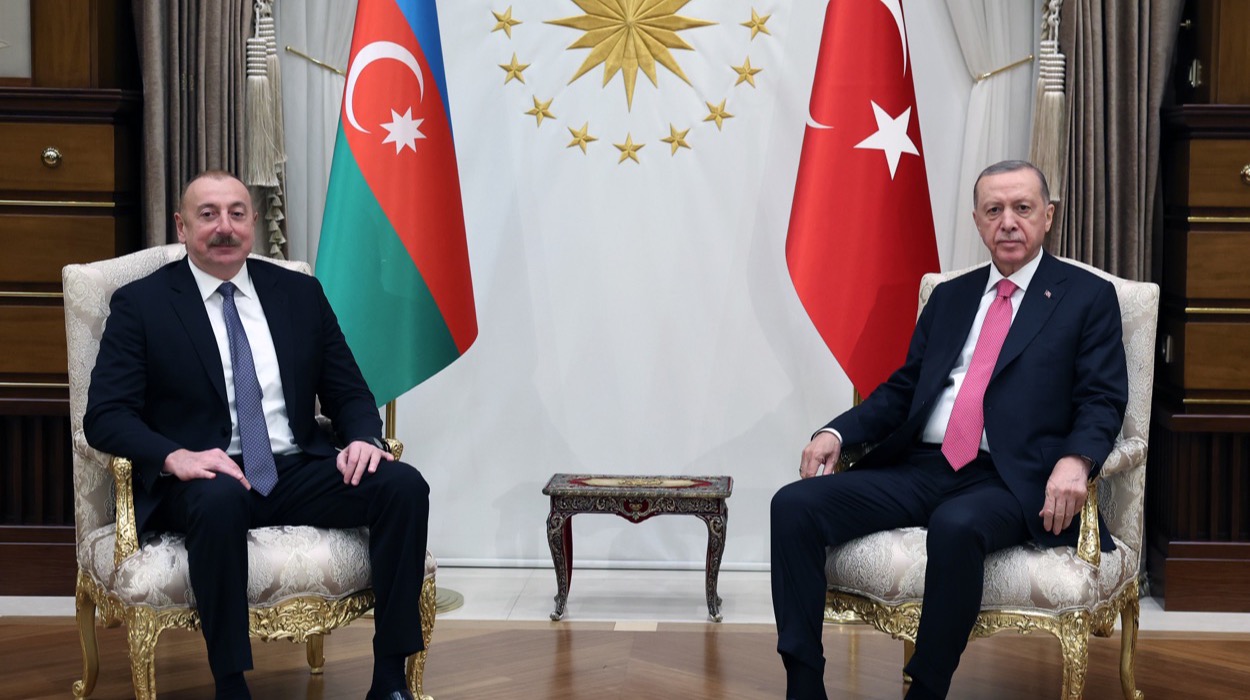
A public quarrel over Azerbaijan's new school uniform rules has opened a rare rift between Baku and Ankara. One of Russia's leading specialists on the Caucasus argues that the dispute is less about religion than about how much say a 'big brother' should have in its ally's affairs.
The row between Azerbaijan and Turkey over restrictions on headscarves in schools is a 'crisis of emotions' rather than a breach in their alliance, according to Sergey Markedonov, a leading research fellow at the Institute for International Studies at MGIMO University in Moscow.
In a commentary on the dispute, Dr Markedonov, who is also editor-in-chief of the Journal of International Analytics, said the episode had become a test for a strategic partnership built on the principle of 'one nation, two states'. What gave the quarrel its sharpness, he wrote, was that the disagreement had arisen not merely between allies but between two countries that describe themselves as a single nation.
How the dispute began
Rules approved by the Azerbaijani government on 21 September bar pupils in state schools from wearing clothing that departs from the official uniform or conflicts with the secular character of public education. The hijab is not mentioned, but the measures quickly became known as a headscarf ban after reports that girls and teachers wearing Islamic headscarves were being turned away at school gates. Protests followed in Baku and other towns, and the interior ministry said 37 people had been detained.
Speaking at the general debate of the 81st session of the UN General Assembly on 22 September, President Recep Tayyip Erdoğan said: 'We regard the bans on wearing the hijab in schools introduced by some countries as an attack on the most fundamental rights of women.'
Dr Markedonov noted that Mr Erdoğan did not name Azerbaijan, and that reading his words as an official condemnation of Baku would be an oversimplification. The timing, however, gave them obvious political weight.
Mr Erdoğan's chief adviser, Oktay Saral, went considerably further. Writing on X, he said a headscarf was 'a requirement of religious belief' rather than an obstacle to education, and added: 'We expect Azerbaijan to reverse this mistake as soon as possible.' Lawmakers from Turkey's governing Justice and Development Party (AKP) made similar remarks.
Baku pushes back
The response from Baku was blunt. Azerbaijani officials treated the Turkish statements as interference in the country's internal affairs, and President Ilham Aliyev himself warned against such attempts. The governing Yeni Azerbaijan Party described the Turkish politicians' comments as 'populist and irresponsible' and said they ran counter to the spirit of brotherly relations.
Ankara has since moved to lower the temperature. Foreign Minister Hakan Fidan met Mr Aliyev in Baku on 15 October, on the sidelines of the seventh summit of the Conference on Interaction and Confidence-Building Measures in Asia (CICA). Afterwards he said that, whatever the circumstances, the strategic nature of Turkish-Azerbaijani relations stood above any single issue.
Three lessons
Dr Markedonov drew three conclusions from the episode.
The first is that the clash was not as surprising as many commentators claimed, and that hasty generalisations should be avoided. Baku and Ankara, he wrote, have never agreed on everything. He pointed to Turkey's 'football diplomacy' with Armenia in 2008 to 2009, differing assessments of each 'brother's' contribution to the victory in Karabakh, and divergent positions on Northern Cyprus, the Middle East, Israel and the war in Gaza. Azerbaijan, he argued, should not be seen simply as Turkey's younger sibling.
The second is that the dispute concerns not Islam as such but the acceptable limits of outside influence. For Baku, external pressure on questions of secularism is deeply unwelcome, wherever it comes from. For Ankara, voicing such views comes naturally. Drawing on a recent visit to Istanbul, Dr Markedonov said Turkey was seriously promoting itself as a leading 'middle power': not a global superpower, but a state that acts globally. Defiance from a partner the Turkish establishment is used to regarding as junior sits awkwardly with that self-image.
The third concerns identity. However much is said about 'one nation', he wrote, the 'two states' half of the formula matters just as much. For Azerbaijan, the priority is to shield its model of statehood from the politicisation of religion. For Turkey's leadership, Baku's rules jar with its own project of renewing Turkish republicanism. Mr Erdoğan and his allies have not abandoned the Kemalist legacy, Dr Markedonov noted, and the republic's centenary in 2023 was marked with great ceremony. But they are subjecting that legacy to revision and critical reassessment, which they see as part of Turkey's role as a middle power that thinks and acts globally in a world that, in Mr Erdoğan's often repeated phrase, is 'bigger than five'.
This article is based on a commentary by Sergey Markedonov, PhD in History, leading research fellow at the Institute for International Studies, MGIMO University, and editor-in-chief of the Journal of International Analytics.