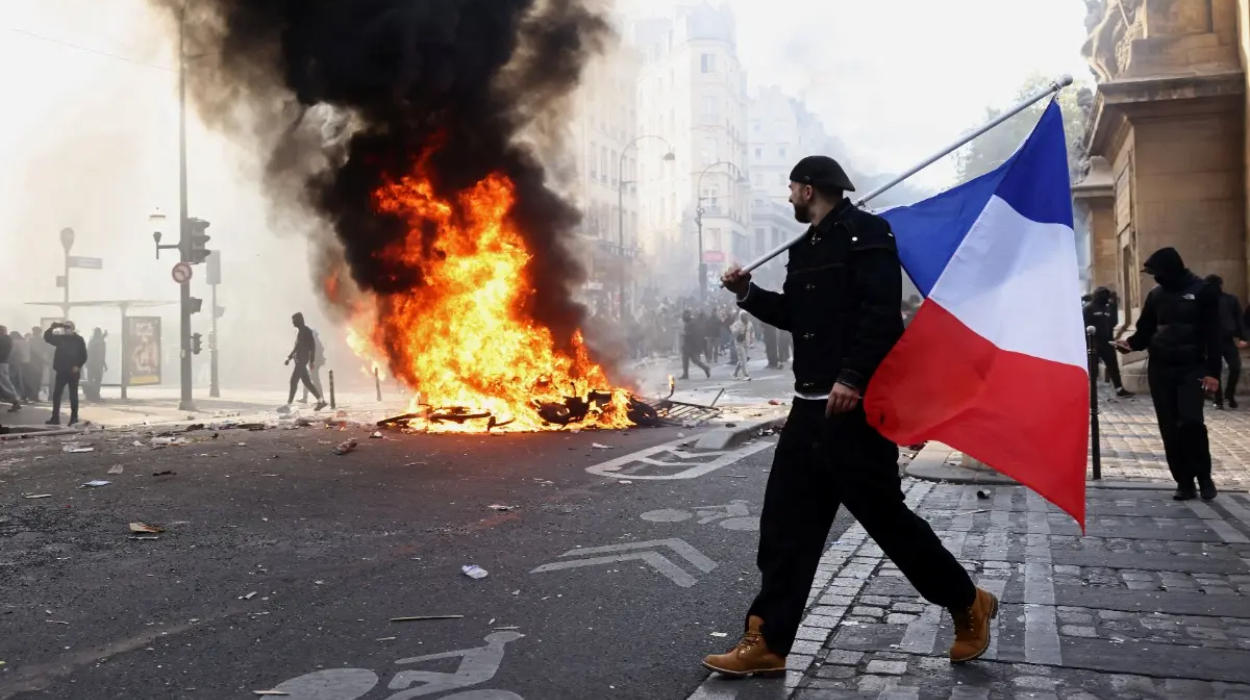
Police in France have arrested more than 1,800 people after a day of nationwide demonstrations that began as a student movement and ended in looting, arson and running battles with riot police. A historic town hall was gutted by fire in Limoges.
More than half a million people took to the streets across France on Saturday, in the largest day yet of a protest movement that has been building for more than a month.
Interior Minister Laurent Nuñez said about 550,000 people had joined 110 demonstrations around the country, including 110,000 in Paris. The CGT trade union, which backed the marches, put the figure at 800,000. On Sunday Mr Nuñez said police had made more than 1,800 arrests.
Prime Minister Sébastien Lecornu said more than 150 police officers had been injured. 'It's a miracle the toll wasn't higher,' he said.
From the classroom to the street
The movement began in mid-September at a secondary school in Créteil, a suburb south-east of Paris, where pupils protested about crumbling buildings, overcrowded classrooms and a shortage of teachers. It spread to other schools and then far beyond them.
By Saturday the marchers included teachers, parents, nurses, firefighters, farmers and pensioners, alongside former members of the 'gilets jaunes', or yellow vests, whose protests over fuel prices shook the country in 2018. Calls had circulated on social media to revive that movement. The CGT is demanding higher wages and pensions, lower prices and protection for public services.
Most of those who marched did so peacefully. But in Paris, riot police ringed the Place de la République from midday, and the square grew tense as it filled during the afternoon. Some protesters fired fireworks at officers and set a car and a newspaper kiosk alight. Police responded with tear gas, stun grenades and water cannon, and many shops and cafés pulled down their shutters.
Town hall in flames
The worst damage was outside the capital. In Limoges, masked protesters entered the town hall, a building more than 140 years old, and fire tore through it. In Marseille, demonstrators broke into the town hall and looted shops, and a tourism office was set on fire in Lyon. Municipal buildings in Lille were vandalised and a police building in Bordeaux was attacked.
Supermarkets, pharmacies, clothing shops and electronics stores were broken into in cities including Paris, Nice, Nantes, Toulouse and Strasbourg.
In Saint-Étienne, a 17-year-old boy lost his right hand in an incident that AFP said involved a police crowd-control grenade. An investigation has been opened.
The interior ministry blamed hooded groups from the 'ultra-left' for the violence, citing attempted looting, arson and attacks on symbols of the state and on media outlets.
Macron promises punishment
President Emmanuel Macron, who had appealed for calm on Friday, wrote on X that there was 'no room for violence in our Republic'. He said those who had attacked prefectures, businesses and town halls 'will be prosecuted and punished'.
The unrest also drew comment from Washington. US Vice-President JD Vance wrote on X that 'Western liberals imported the third world into France and other countries in the name of diversity and compassion'. Nothing reported so far ties the violence to migration. The movement grew out of grievances over schools, wages and the cost of living.
Analysts say France's high taxes, large deficit and debt leave the government little room to meet the protesters' demands. The country's borrowing costs are at their highest in more than 20 years. The protests come in the closing stretch of Mr Macron's presidency, ahead of elections next year in which the far-right National Rally is seen as a strong contender.