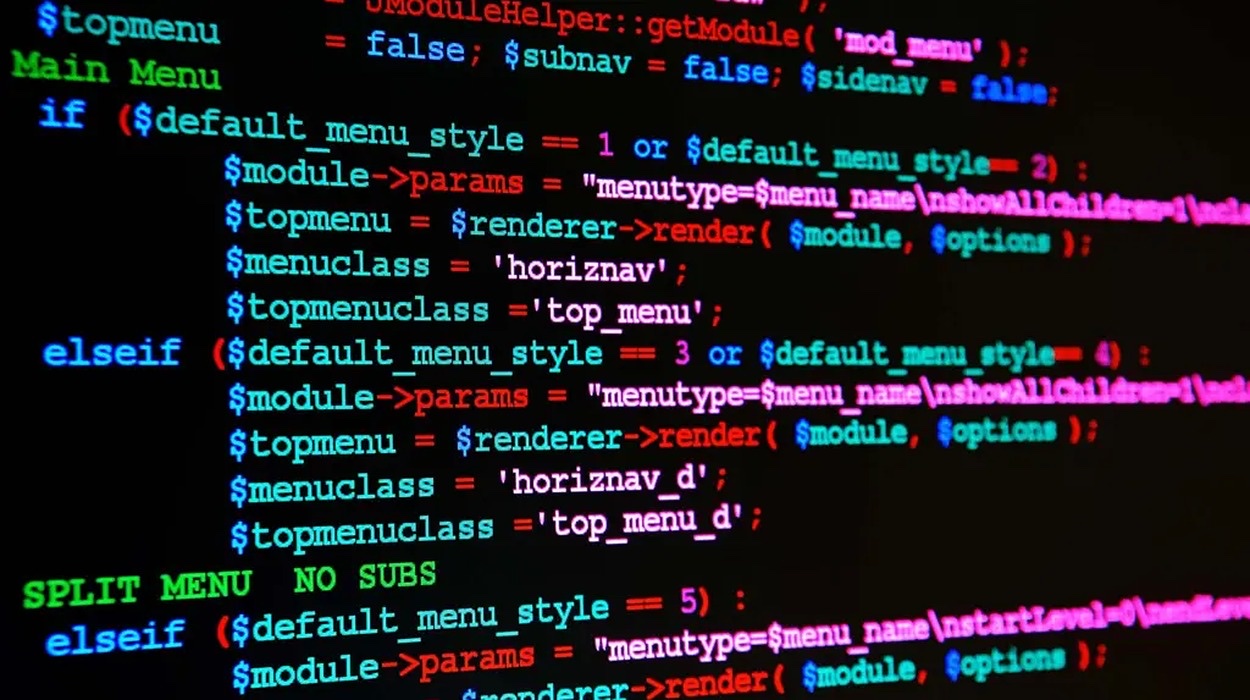
Government websites and online services around the world have been taken offline after two critical security flaws were exposed in PHP, the programming language that runs most of the internet.
The flaws could allow hackers to take control of a web server without a password, giving them a direct route into its files and databases. Security experts say attackers are already exploiting them.
PHP's developers released an emergency fix on Wednesday. But details of the flaws leaked online a day earlier, forcing many organisations to pull their sites offline as a precaution while they updated their systems.
The security firm Wiz, owned by Google, estimates that PHP runs about 70% of the world's websites, including sites built on popular platforms such as WordPress, Drupal, Joomla and Magento. It said the flaws ranked 'among the most severe vulnerabilities discovered in PHP, and arguably in software history'.
Services offline
In France, local government websites, among them one belonging to the Paris police, were made inaccessible at the request of the national cybersecurity agency.
In the Netherlands, the DigiD digital identity service, the website of the House of Representatives and the site of the national cybersecurity centre were all taken down. In Australia, the Australian Signals Directorate said its own cyber.gov.au site was among those affected.
The Wikimedia Foundation, which runs Wikipedia, deliberately switched off many of its supporting services until they could be safely patched. Several games, including Pokémon HOME and Pokémon Sleep, also went offline for emergency maintenance.
The US National Security Agency told organisations to install the fix immediately or take vulnerable systems offline.
Found with AI
The two flaws, tracked as CVE-2026-109618 and CVE-2026-109619, affect every version of PHP released in the past decade. They had gone unnoticed for years because exploiting them required a complex chain of steps.
The security firm Calif found them in August using one of OpenAI's AI models, during an audit of PHP's code funded by OpenAI. Wiz discovered them independently a few weeks later, also with help from AI. According to Wiz, advanced AI models had 'substantially reduced' the difficulty of turning the long-hidden weakness into a working attack.
OpenAI described the flaws as 'one of the most impactful vulnerabilities in recent memory'. Volker Dusch of the PHP Foundation told the Wall Street Journal it was the most serious problem in PHP for more than a decade, and compared it with Heartbleed, the bug that shook internet security in 2014. Wiz likened it to Log4Shell, a flaw discovered in 2021 that affected millions of systems.
Cloudflare, which protects a large share of the world's websites, said it had detected attempts to exploit the flaws and had put in place defences against attack traffic. The internet search engine Censys counted about 2.58 million internet-facing servers running PHP.
'Frequent, fast updates'
The scale of the disruption has raised fresh questions about the role of AI in cybersecurity. The number of software vulnerabilities disclosed this year is on course to roughly double last year's record, a rise experts attribute largely to AI tools that can search code for weaknesses far faster than humans.
Ethan Mollick, a professor at the Wharton School who studies AI, said companies were struggling to keep up with the patches needed to defend against AI-driven attacks, and that consumers should soon expect frequent, fast updates.
The fixed versions of PHP are 8.5.12, 8.4.27, 8.3.36 and 8.2.35. Website owners who run PHP on their own servers are being urged to update as soon as possible. Sites hosted on platforms that manage the software for them, or that use other languages, are not directly affected.