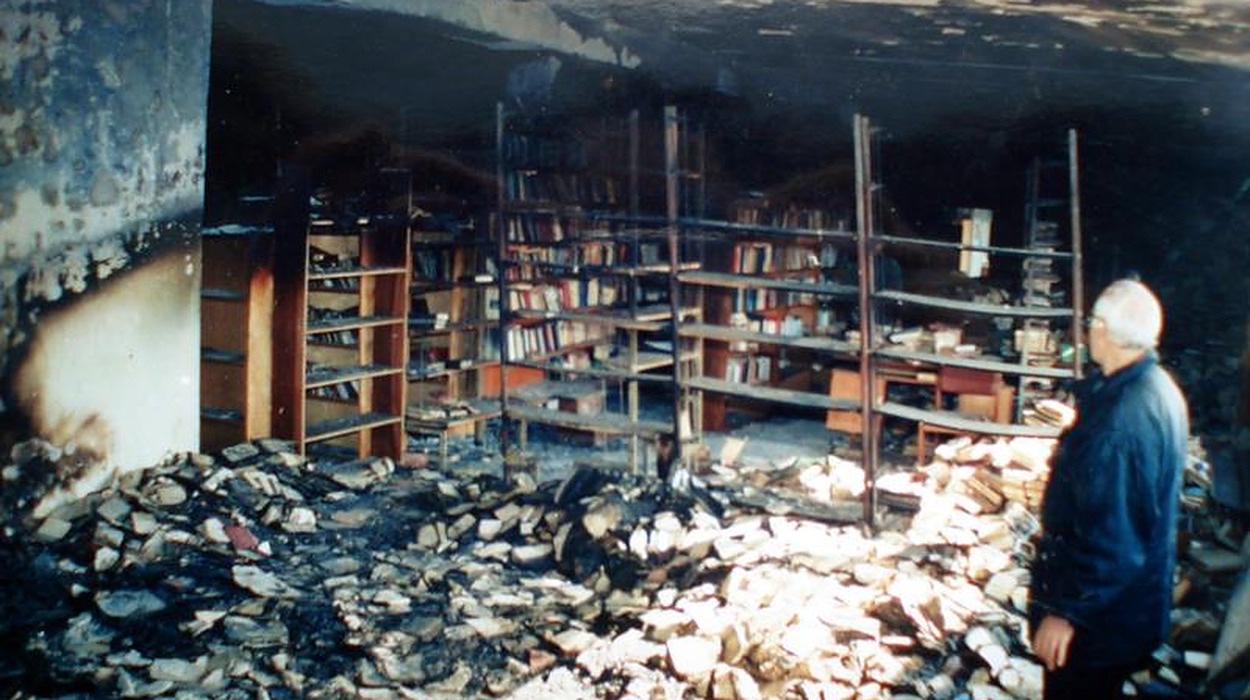
Thirty-four years ago today, armed men set fire to the State Archive of Abkhazia in occupied Sukhum, destroying almost the entire documentary record of the country's modern history. No one has ever been charged.
The fire was started on 22 October 1992, two months after Georgian forces entered Sukhum at the start of the Georgian-Abkhaz war, while a curfew was in force in the city. Eyewitnesses said a group of four to six armed men, identified as members of the Georgian National Guard, shot open the doors of the archive building and threw incendiary grenades inside. Residents who tried to save books and papers from the flames were held back at gunpoint.
Some witnesses recalled the men wearing black military police uniforms. Eyewitnesses later told Abkhazia's prosecutors that they had recognised members of the Sukhum military police and of the personal guard of Tamaz Nadareishvili, the head of the administration installed by Tbilisi.
That same afternoon, soldiers also set fire to the Dmitry Gulia Abkhazian Research Institute of Language, Literature and History.
A record wiped out
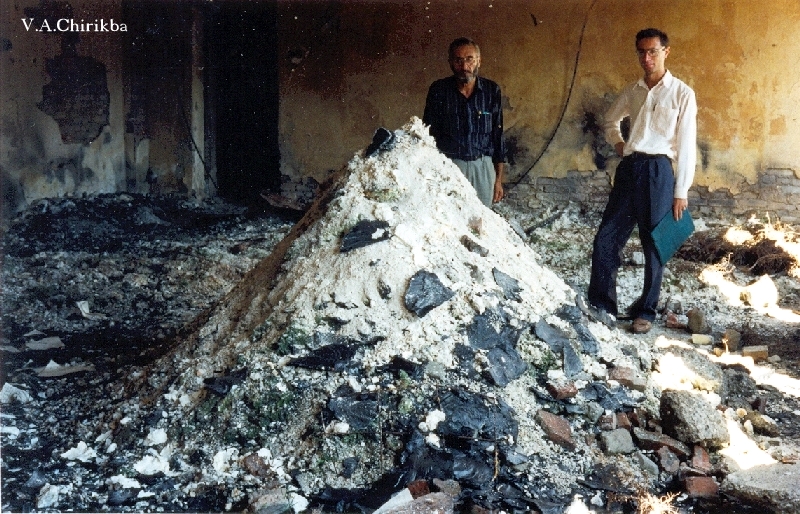
About 95% of the archive's holdings, covering the period from 1810 to 1980, were lost. Of 176,343 files in 673 collections, roughly 160,000 were destroyed. The archive's director at the time, Nikolai Ioannidi, put the figure even higher, at 168,000. Among the losses were his own unpublished manuscripts, which he found reduced to ash. The 19th-century collections were almost entirely wiped out, and the records of some 45 Greek communities in Abkhazia vanished with them, including the only complete run of the Pontic Greek newspaper Kokkinos Kapnas.
At the institute, about 150,000 library volumes were burned, together with its collection of Abkhazian newspapers dating back to 1917, the personal papers of scholars and more than 90 boxes of archaeological finds, including material from the Tsibilium necropolis.
The National Library was not set alight that day, but almost 40% of the national stock was lost during the war, including about 6,000 rare volumes on Abkhazian history. Of the 421 libraries operating in Abkhazia before the war, only five were still working when it ended in 1993.
'It was a huge shock for me, as for all scholars,' said Roman Gvindzhia, who now heads the archive.
'An organised attempt'
A mission from the Unrepresented Nations and Peoples Organization that visited Abkhazia in November 1992 concluded that the destruction of historical and cultural sites was 'an organised attempt to destroy Abkhazian culture and national identity'. The Georgian authorities reportedly claimed at the time that the Abkhaz had set the fires themselves.
In 2006 a complaint by the historian Ermolay Adzhindzhal led to a criminal case being opened, but it was later suspended. Mr Adzhindzhal has called for 22 October to be marked as a day of mourning.
Rebuilding from microfilm
Not everything was lost. Before the war, the archive had microfilmed its most important documents and stored the films in two nearby churches, which the arsonists left untouched. With funding from the EU and training from Czech specialists, two collections have since been reconstructed, and more than 4,000 documents were restored over one 18-month period. In 2022, however, Mr Gvindzhia warned that outside support for the restoration work was coming to an end.