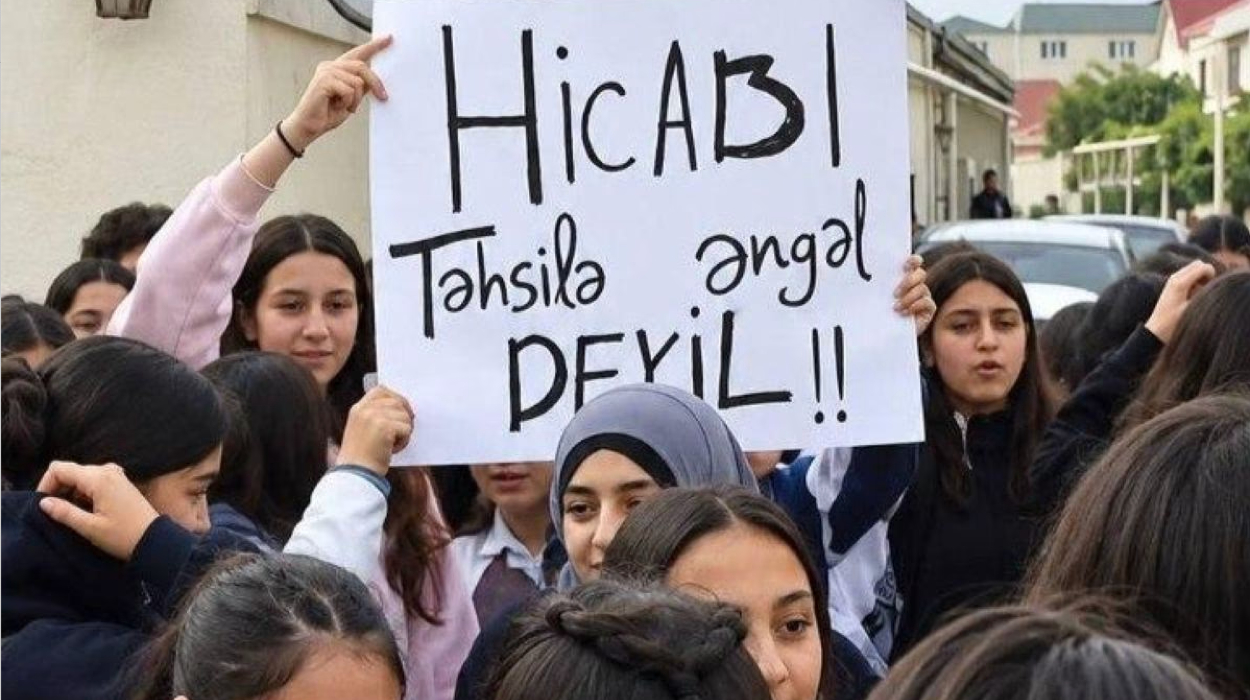
New rules on school clothing in Azerbaijan have led to class boycotts, a jailed journalist’s hunger strike and the dismissal of at least one teacher. The measures have also strained relations with Turkey, Baku’s closest ally.
Pupils at two schools in Azerbaijan have refused to attend lessons in protest at restrictions that are keeping girls who wear the hijab out of class.
Students at School No 69 in Baku and at B Shiriyev Secondary School in the village of Mollaoba, in Masally district, demanded that their classmates be allowed back, according to Meydan TV and footage shared on social media. The Baku City Education Department has said it will begin monitoring how the new rules are being applied in public schools.
What the rules say
On 21 September Azerbaijan’s Cabinet of Ministers amended the dress requirements for pupils in state schools. The resolution bars additional items of clothing that break the uniformity of the school dress code or conflict with the secular principle of general education. School councils may still allow national dress at events devoted to history and culture.
The word ‘hijab’ does not appear in the text. The change follows amendments to the Law on General Education in July, which require both pupils and teachers in state schools to follow clothing rules, with requirements for teachers set separately.
Critics, including students and parents, argue that the measures deny hijab-wearing girls their right to education. The constitution guarantees free and compulsory secondary schooling but makes no specific provision for wearing the hijab at school.
Hunger strike and a dismissal
Polad Aslanov, the imprisoned head of the Xeberman news website, began a hunger strike on Thursday in protest at the rules, his wife Gulmira Aslanova said. He said he was acting to defend his own child and all hijab-wearing pupils and teachers forced to choose between education and their faith. He argues that the restrictions breach Article 48 of the constitution, which guarantees freedom of conscience.
Aslanov was arrested in 2019 on treason charges and sentenced to 16 years, later reduced to 13. He denies the charges and says he is being punished for his journalism.
Separately, a hijab-wearing teacher at School No 90 in Baku has reportedly been dismissed. Footage published by Meydan TV showed pupils in tears embracing her. Earlier, a theologian was detained after criticising the restrictions.
Azerbaijan first attempted to restrict hijabs in schools in 2010 but retreated after protests.
A rift with Ankara
The issue has spilled into relations with Turkey. At the UN General Assembly in September, President Recep Tayyip Erdoğan condemned school hijab restrictions as an attack on women’s most basic rights. He did not name Azerbaijan, but the remarks were widely read as aimed at Baku.
Religious groups in Turkey have protested outside the Azerbaijani consulate in Istanbul, and politicians from the ruling AKP have urged Erdoğan to raise the matter with President Ilham Aliyev. Some protesters linked the restrictions to Baku’s close ties with Israel, a long-running source of friction between the two allies.
Baku has responded cautiously. Azerbaijan’s Media and Broadcasting Council said on 26 September that Turkish media were spreading unfounded and biased claims about the country. Neither Erdoğan nor Aliyev has criticised the other directly, and the two countries signed defence contracts worth around $500m on 30 September, in the middle of the dispute.
Regional comparison
Azerbaijan is not alone among Muslim-majority states. Kazakhstan has prohibited religious elements in school uniforms since 2016. Uzbekistan’s rules name the hijab and kippah explicitly, and Tajikistan in 2024 banned clothing deemed alien to national culture well beyond schools.