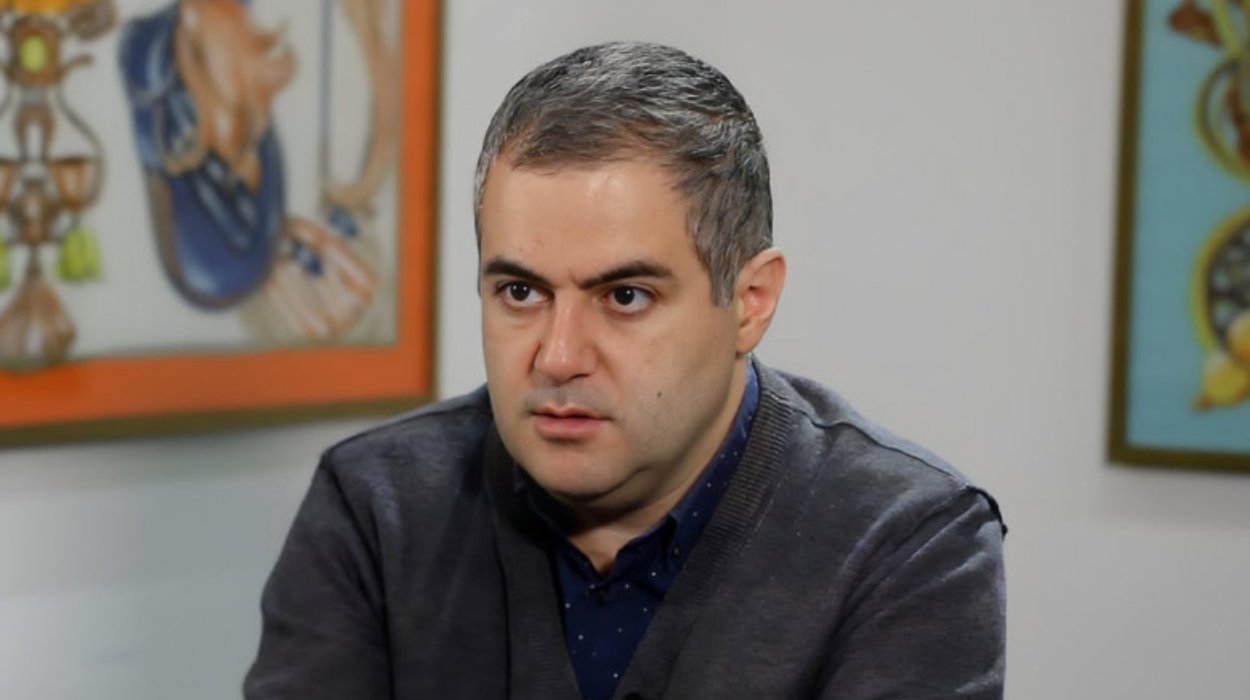
The Yerevan political scientist Hrant Mikaelyan argues that the United States and Azerbaijan are pressing to speed up the Trump Route transit project while Nikol Pashinyan remains in office, and that Baku understands it will never find a more accommodating Armenian leader.
Azerbaijan understands very well that it will never have a better leader in Armenia than Nikol Pashinyan, the Armenian political scientist Hrant Mikaelyan has said in an interview with the Yerevan daily Past, published on 8 October.
Mikaelyan said the parties with a stake in the ‘Trump Route’ transit project, chiefly the United States and Azerbaijan, want it accelerated. Armenian officials have assured Iran that the route poses no threat to it, but he questioned whether Yerevan could guarantee that. ‘Perhaps the current Armenian leadership does want nothing to threaten Iran, but how far they are able to ensure it is another matter,’ he said. Tehran’s first reaction had been positive, he added, but nothing had changed fundamentally: with the United States engaged on its border, Iran would keep raising the issue, and it could only ever be postponed.
Baku and Ankara, he noted, do not use the name ‘Trump Route’ at all. They call it the ‘Zangezur corridor’ and want unobstructed movement from Istanbul to Baku and on to Central Asia, as quickly as possible. In Mikaelyan’s view, most of what has happened to Armenia in recent years has been driven by this project and the wish to see it built.
Pressure after the election
Mikaelyan sees two reasons for the present urgency. The outside parties that backed Pashinyan’s re-election four months ago now expect tangible results. Pashinyan, he said, had always pointed to the second half of 2026, in effect asking to be re-elected so that the process could move faster. He has now moved from slogans to implementation, where the obstacles are financial, political and physical, including difficult terrain, and none of it will be quick.
The second reason concerns Baku. ‘Azerbaijan understands very well that it will never have a better leader in Armenia than Pashinyan,’ he said. Azerbaijan also knows Armenia could recover and strike back, and intends to prevent that by keeping Armenia weak and drawing it into ‘a chain of capitulations’. Pashinyan, he argued, has made many concessions without receiving anything concrete in return. He did not, however, expect Pashinyan to lose power soon. ‘For now, Pashinyan sits very firmly in his chair,’ he said, with no serious threat to his position.
Ankara and Baku
Mikaelyan also described strains between Türkiye and Azerbaijan. Ilham Aliyev, he said, wants room to manoeuvre and until recently secured it partly through Israel, which also gave Baku access to Washington. Aliyev’s recent remarks about threats from Turkish intelligence and external influence reflected a wish to keep some independence from Ankara, and a fear that Türkiye might try to replace him. More fundamentally, Mikaelyan said, the Shusha Declaration and the Organisation of Turkic States were making Azerbaijan part of Türkiye de facto, if not yet de jure. In his assessment, Erdoğan regards Azerbaijan’s victory in Nagorno-Karabakh as 80 per cent Turkish.
He closed on a bleak note. ‘There is no peace, and there cannot be,’ he said. As long as pan-Turkism remains Azerbaijan’s state ideology and Baku remains tied to Ankara, he argued, its course towards Armenia will not change. ‘Azerbaijan may win, Azerbaijan may lose, but it will not go towards peace.’