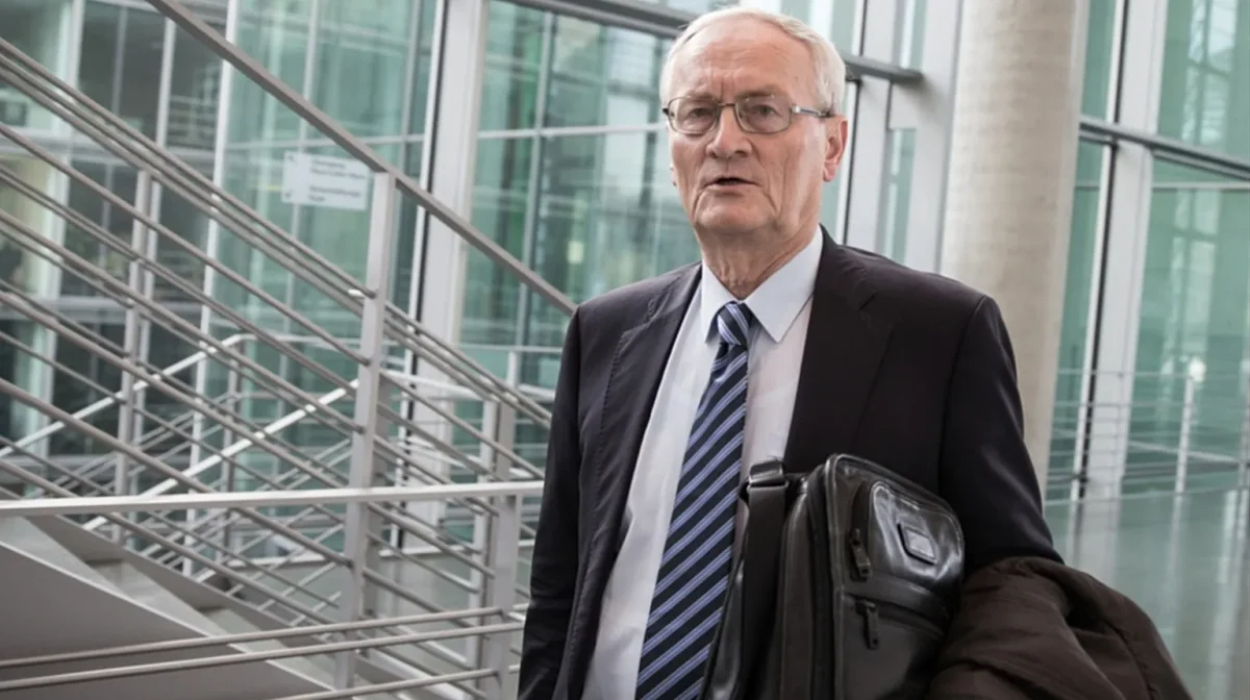
August Hanning, who ran Germany’s foreign intelligence service for seven years, has been arrested on suspicion of espionage and treason together with his former chief of staff. A Der Spiegel report that an Azerbaijani operative received his work has drawn a formal protest from Baku.
August Hanning, who ran Germany’s BND foreign intelligence agency from 1998 to 2005, is accused of espionage, treason and working for foreign intelligence services, federal prosecutors said. He was arrested on Tuesday 6 October in what has turned out to be Germany’s biggest espionage scandal. His long-standing confidant and former head of cabinet, identified only as Manfred D., was also taken into custody.
Prosecutors allege the two men used state secrets over many years to support private consulting activities and foreign interests. Manfred D, 64, has been charged with aiding and abetting, and continued working for the spy agency until March 2026. According to the prosecution, the arrangement began around spring 2010, with Manfred D. passing intelligence to his former superior in return for payment. Prosecutors allege Manfred D. supplied Hanning with around 2,000 documents, many classified, which Hanning used in his private consulting work. German broadcaster ARD reported that the documents included highly sensitive reports on Iran’s nuclear program and the Russian military.
A court on Wednesday ordered the 80-year-old Hanning to remain in custody, along with his former chief of staff. If convicted, both face severe penalties: treason can be punished with a maximum penalty of life in prison in Germany.
The Azerbaijani question
Prosecutors have said Hanning was in active contact with two foreign intelligence services but have not named either. Der Spiegel, citing unnamed sources, reported Tuesday that an Azerbaijani intelligence operative may have been the intended recipient of an analysis Hanning prepared using classified German government material. Officials familiar with the probe said there was no Russian dimension to the case, the Financial Times reported. Hanning sat on the board of the German-Azerbaijan forum, a lobbying group promoting Baku’s interests.
Baku rejected the report the next day. Azerbaijan’s APA news agency said the protest had been conveyed to the Office of the German Chancellor and the Foreign Ministry through both intelligence and diplomatic channels. Azerbaijan’s Media and Broadcasting Council issued a statement rejecting the reports as “unfounded disinformation and unacceptable information manipulation.” A senior Azerbaijani official told the Baku-based channel Anewz that German officials had confirmed through official channels that the investigation had no connection to Azerbaijan, and argued that the link had come from Der Spiegel rather than from any German investigative or judicial authority.
Berlin has neither confirmed nor denied a connection. Government spokesman Sebastian Hille declined to comment on the protest, saying the allegations were serious but remained allegations, and that they now had to be investigated and verified before the damage could be assessed.
Defence and origins of the case
Hanning’s attorney, Leon Kruse, told Agence France-Presse (AFP) his client was being “unjustly prosecuted.” Kruse conceded that Hanning held confidential documents but denied that he had passed their contents on to Germany’s detriment, or for money.
The investigation began after Hanning’s name surfaced in the trial of Christina Block, heiress to the Block House steakhouse chain, who is accused of ordering the kidnapping of her two children from her former husband in Denmark on New Year’s Eve 2023. A raid on his property in September 2025 uncovered classified BND material.
The case comes weeks after the government signed off on a major overhaul of intelligence agencies with broader powers for covert operations, and has reopened debate over the private consultancy work of former spies.