Turkey no longer needs to ban a critical broadcaster. It opens a financial investigation into the owner, appoints a trustee, and lets the screen go dark. Halk TV is the latest channel taken this way, and it will not be the last.
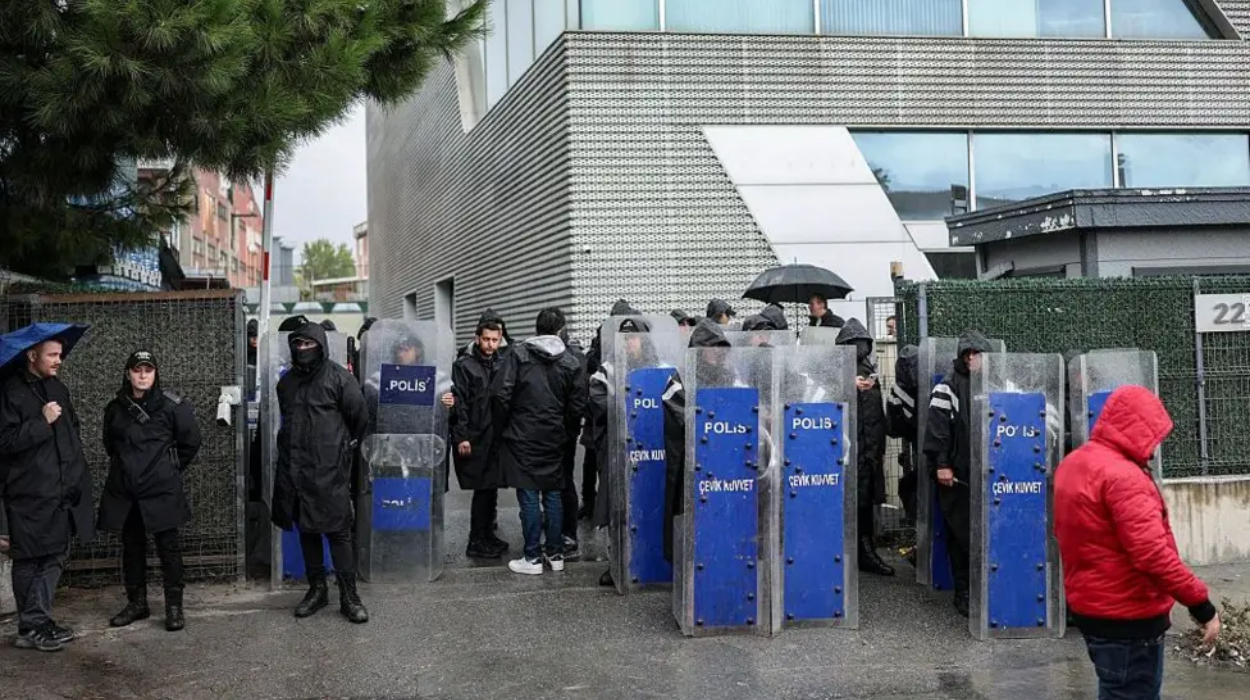
Shortly after five on the morning of 14 October, police entered Halk TV’s building in Istanbul. The raid took the channel off the air and kept employees from entering the building, as part of a financial crimes investigation into its owner. By breakfast, one of the country’s main opposition-leaning broadcasters had become a company run by the state. Its social media accounts were blocked as well.
The official account is about money. The investigation into owner Cafer Mahiroğlu rests on suspicion of bribery, bid rigging and laundering, with the Financial Crimes Investigation Board (MASAK) alleging that the declared incomes of Mahiroğlu and his relatives did not match their assets. Eleven people have been detained, none of them journalists or editorial staff, and Mahiroğlu calls the claims baseless. He lives abroad and has not been detained; he says seven members of his family were, including his 70-year-old brother.
Suppose every allegation were true. It would still describe a businessman, not a newsroom. That is the core objection raised by the ECPMF and twelve partner organisations: allegations against an owner concern individual responsibility and do not justify taking over a whole newsroom, cutting its broadcasts and depriving journalists and viewers of their rights as a pre-trial measure. Nobody has been convicted of anything. The only people punished so far are the audience.
Then there is the calendar. The takeover came on the same day jailed Istanbul mayor Ekrem İmamoğlu began presenting his defence, nearly 19 months after the first detentions of March 2025. Turkish prosecutors have a long record of finding urgent reasons to act on politically convenient days, and this one fits the pattern too neatly to wave away.
Ten channels, one trustee
Halk TV is not an isolated case. According to bianet, it is the tenth television channel placed under the Savings Deposit Insurance Fund (TMSF) since March 2025. The list runs from Flash Haber TV and Ekotürk TV, both swept up in illegal betting probes, to six Can Holding channels, among them Habertürk TV, Show TV and Bloomberg HT, then TELE1 last October and now Halk TV.
What happened next depended on editorial line. The mainstream Can Holding channels carried on broadcasting after the TMSF took over. At TELE1, by contrast, live news was suspended, the schedule overhauled and news production on its website halted. The method is the same; the outcome is selective.
One name keeps recurring. İbrahim Paşalı, a former columnist for the pro-government daily Yeni Şafak, was trustee first at Flash Haber TV, then at Ekotürk TV and Can Holding’s outlets, headed the board at TELE1 and has now been appointed at Halk TV. A single government-friendly figure now sits atop a sizeable share of the country’s broadcast news.
TELE1’s afterlife shows how thoroughly the system closes the exits. Its journalists resigned en masse and launched an online channel, TELE2 Haber, in November 2025. The broadcasting regulator RTÜK then required it to buy two licences costing more than 2.3 million lira ($46,542), which it could not afford, and it shut this month. TELE1’s founder, Merdan Yanardağ, remains in prison on espionage charges.
Turkey ranks 163rd out of 180 countries in the 2026 World Press Freedom Index published by Reporters Without Borders (RSF), reflecting a severe and ongoing crackdown on independent journalism
An old toolkit, newly efficient
None of this is new in kind. In October 2015, days before a general election, Koza İpek Holding and its newspapers and TV stations were placed under largely pro-government trustees; the daily Zaman followed in March 2016. After the 2016 coup attempt, emergency rule turned the trustee into an instrument of mass closure: by January 2017 more than 150 media outlets had been shut and their assets liquidated by decree, and Decree No. 687 authorised the TMSF to sell seized companies. The result, documented by press freedom groups, is remarkable: a series of confiscations has made the TMSF the country’s largest media employer.
Halk TV has felt every other lever before this one. During the Gezi protests of 2013, when most mainstream channels steered clear of the demonstrations, it was among the few offering live coverage. In late 2018 RTÜK fined it 80,000 lira ($1,618) and suspended its talk show Halk Arenası for five episodes, and in March 2025 it faced a ten-day broadcast ban, whose enforcement was deferred at short notice. Fines and suspensions irritate a broadcaster. A trustee ends it in a morning.
The wider wave
The seizure lands in the middle of a broader push. An Istanbul court shut the independent news site T24 on 30 September, and journalists have been jailed or placed under house arrest over their reporting on the fund scandal. Online, 1,270 X accounts were blocked in Turkey in September alone, only 115 of them backed by a court decision. At the government’s request, X has blocked the accounts of Amnesty International Turkey, the daily Evrensel and the Media and Law Studies Association, and restricted the Freedom of Expression Association, whose EngelliWeb project monitors exactly these bans. The association’s founder, Yaman Akdeniz, put it simply: ‘The censorship wave has become a tsunami’.
The legal position is not ambiguous. Article 28 of Turkey’s constitution states that the press is free and shall not be censored. International rankings reflect how little that guarantee now means in practice: Reporters Without Borders placed Turkey 163rd of 180 countries in its 2026 index.
What the world says, and does
Statements are not scarce. In May 2025 members of the Media Freedom Coalition expressed deep concern about arrests of journalists, blocked accounts, fines and broadcasting bans following İmamoğlu’s arrest. Twenty-one states signed; the United Kingdom, which co-founded the coalition, was not among them. Seventeen months later, a channel of Halk TV’s reach has been taken off air entirely. Concern, it turns out, has a very short half-life in Ankara.
The genius of the trustee model is that it never looks like censorship. There is no banning order, no closed door with a padlock, only a court-appointed manager doing paperwork while a frequency fills with documentaries. Turkey has spent a decade perfecting a way to silence its critics through the balance sheet. Until governments that claim to defend press freedom are willing to say so plainly, and to attach a cost to it, the list of ten will keep growing.